SDS 220: Introduction to Probability and Statistics
| Time: | Section 1: Monday/Wednesday/Friday 9:25 am - 10:40 am Section 2: Monday/Wednesday/Friday 10:50 am - 12:05 pm |
|
| Location: | Sabin-Reed 301 | |
| Instructor: | Rebecca Kurtz-Garcia (she/her/hers) |
|
| Office Hours: | Burton 314 Monday 4:00 pm - 5:00 pm Wednesday 1:30 pm - 2:30 pm |
|
| Slack Info: | Section 1: SDS-220-01-202401 Section 2: SDS-220-02-202401 |
*This course is based on the 201/220 courses by Ben Baumer, Kaitlyn Cook, Scott LaCombe, and Will Hopper
Description
An application-oriented introduction to modern statistical inference: study design, descriptive statistics, random variables, probability and sampling distributions, point and interval estimates, hypothesis tests, resampling procedures and multiple regression. A wide variety of applications from the natural and social sciences are used. Prerequisite: MTH 111 or equivalent. Corequisite: SDS 100.
Textbook
- [IMS] Introduction to Modern Statistics by Mine Çetinkaya-Rundel and Johanna Hardin. Available for free online.
Supplemental Textbooks
[MD] ModernDive: Statistical Inference via Data Science, 1st edition, by Ismay and Kim. Available for free online.
[OI] OpenIntro Statistics, 4th edition, by Diez, Cetinkaya-Rundel, and Barr. Available for free online.
Course Grade
[25%] Homework: Homework will be assigned on an approximately weekly basis and will generally be due on Fridays at 5 p.m. All assignments should be completed using Quarto and submitted online via Moodle.
[24%] Project: You will work in groups to conduct a statistical study on a topic of your choice. Detailed instructions for this project will be given out in class.
[36%] Exams: There will be three self-scheduled, closed-book exams.
[15%] Engagement: Course engagement primarily entails attending course meetings, working on and submitting in-class activities, and participating. Work on in-class activities is graded on a satisfactory/unsatisfactory scale. To earn a satisfactory mark, you must make a reasonable attempt to complete each part of the activity; your answer does not need to be correct to earn a satisfactory mark. There is no make up for in-class activities, but there are four drops.
Extensions
For due date extension requests on Homework and Labs please use this form: https://forms.gle/2dAtK1X6NaGFEwYPA. A late work request must be submitted before the assignment due date. Below are the requirements based on the different extension requests:
24 hrs or less: Almost always be approved. You can assume it has been approved even if you do not get an email from me.
Between 24-48 hrs: Requests should be due to a more serious reason. If there have been a lot of extension requests in this bracket we may ask for documentation. These requests are not automatically approved, you will get a follow up email regarding your request.
Above 48 hrs: Should be a college approved excuse. Documentation is often asked for. You will get a follow up email regarding your request.
You do not need to provide extensive details for the reason for your request, just a general idea. Late assignments will be penalized at the rate of 1 point per day.
Homework Grading
Homework are graded on an ordinal 5/4/3/2/1/0 scale that rewards a combination of accuracy and effort:
[5 Points] All problems completed with detailed solution and with \(\geq 75\%\) of the solutions fully correct.
[4 Points] All problems completed with detailed solutions and with \(50-75\%\) of the solutions correct; or nearly all problems completed with detailed solutions and with \(\leq 75\%\) of the solutions correct.
[3 Points] Nearly all problems completed with detailed solutions and with \(\leq 75\%\) of the solutions correct.
[2 Points] More than half (but fewer than all) problem completed with \(\geq 75\%\) of the solutions correct.
[1 Points] More than half (but fewer than all) problem completed with \(<75\%\) of the solutions correct; or less than half of the problem completed with detailed solutions.
[0 Point] Work is not submitted or is submitted late without prior notice less than half of the problems completed without detailed work supporting the solutions.
Further note:
One point will be deducted if superfluous information is printed or if assignment is excessively long.
All HW problems should be submitted to Moodle compiled from a Quarto file.
The default deadline is 5 pm on Friday (unless otherwise noted).
Please see the Extension policy and the Late submission policy.
Course Communication
All course materials—including lecture slides, handouts, assignments, etc- will be posted on the course website. Grades will be posted on the class Moodle. Course communication will otherwise occur via our SDS 220 Slack workspace. In particular, I ask that you please not email me with course-related questions, but rather post these questions in the appropriate Slack channel. If discretion is needed, please feel free to email me. During the week, I will try my best to answer all messages within 24 hours of receiving them. If you message me over the weekend, however, responses may be delayed.
Resources
The Spinelli Center for Quantitative Learning(Seelye Hall 207) supports students doing quantitative work across the curriculum. In particular, the following resources may be helpful for this course:
Statistics and data science (SDS) tutors are available on a drop-in basis. These students are trained to help you with your statistics and R coding questions. The SDS tutors are available from SMWTh in 7pm - 9pm evenings. See the website for the most up to date information.
The Data Research and Statistics Counselor keeps both drop-in hours and self-scheduled appointments.
Technology in Class
We will use the R statistical software package extensively and exclusively. R and RStudio are open source software that are available for free on Mac, Windows, and Linux operating systems. You have two options for using RStudio:
- The server version of RStudio on the web http://rstudio.smith.edu. The advantage of the server version is that all work is stored in the cloud, automatically saved, and backed up. This means that you can access your work from any computer with a web browser (Firefox is recommended) and an internet connection. You can access the server remotely using a VPN.
- A desktop version of RStudio installed to your machine. This is recommended, we will not be doing any analyses that will overwhelm your computer. However, you are free to choose either you prefer.
Note that you do not have to choose one or the other and you may indeed use both. However, it is important that you understand the distinction so that you can keep track of your work. Both R and RStudio are free, open-source software, and are installed in most computer labs on campus. If you do not have a laptop, please see Smith’s Laptop Loan program.
Expectations
This is a 4 credit course, meaning that by federal guidelines, it should consume about 12 hours per week of your time. We meet for 4 hours per week. That means you should be spending about 8 hours per week, or nearly 90 minutes per day, on this course outside of class.
I also encourage you to work collaboratively with your peers on homework and labs as well as your group project throughout this course. However, when working together you are required to turn in your own responses (no copying and pasting sentences or code from a peer). Please note who you collaborated with at the bottom of your homework and labs. If you collaborate you must give credit to collaborators on homework.
I expect you to adhere to the Smith College Honor Code:
“Smith College expects all students to be honest and committed to the principles of academic and intellectual integrity in their preparation and submission of course work and examinations. Students and faculty at Smith are part of an academic community defined by its commitment to scholarship, which depends on scrupulous and attentive acknowledgement of all sources of information, and honest and respectful use of college resources.”
Dishonesty and plagiarism are serious violations of the Honor Code and will be reported to the Academic Honor Board. See here for more information on the honor code. By far, the most frequent violation of the honor code is accidentally not citing a source or giving proper credit.
Accommodation
Smith is committed to providing support services and reasonable accommodations to all students with disabilities. To request an accommodation, please register with the Disability Services Office at the beginning of the semester. To do so, call (413) 585-2071 or email ods@smith.edu to arrange an appointment.
Classroom Environment
We are committed to fostering a classroom environment where all students thrive. We are committed to affirming the identities, realities and voices of all students, especially those from historically marginalized or underrepresented backgrounds. We are dedicated to creating a space where everyone in the class is respected, is free from discrimination based on race, ethnicity, sexual orientation, religion, gender identity, disability status, and other identities, and feel welcome and ready to learn at your highest potential.If you have any concerns or suggestions for how to make this class more inclusive, please reach out to your instructor. We are here to support your learning and growth as data scientists and people!
Feedback
Your experience is important to me. Please use the following link to provide instructor feedback at any point during the course: https://forms.gle/81DGL1CsTjGMWUwr8. Responses can be anonymous.
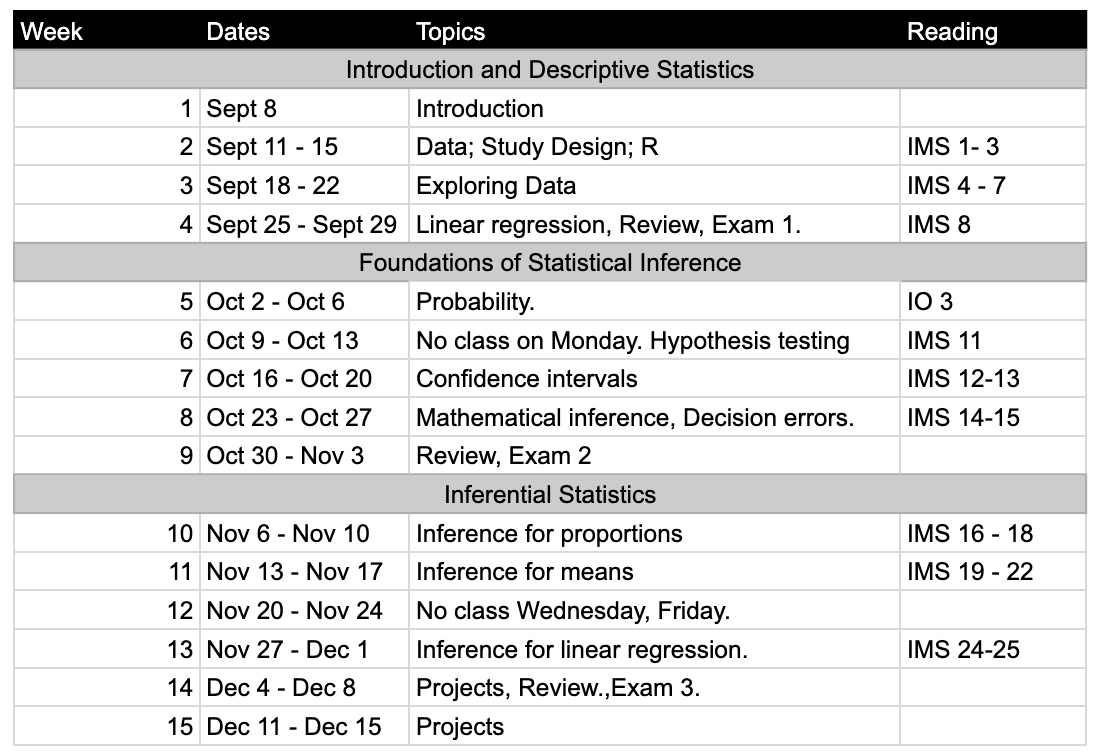
Approximate Schedule
Below is an approximate schedule showing an outline for the class material.